
Choose wood-grain film for a set of trim parts by reviewing grain direction, pattern scale and adjacent edges together before approving a sample.
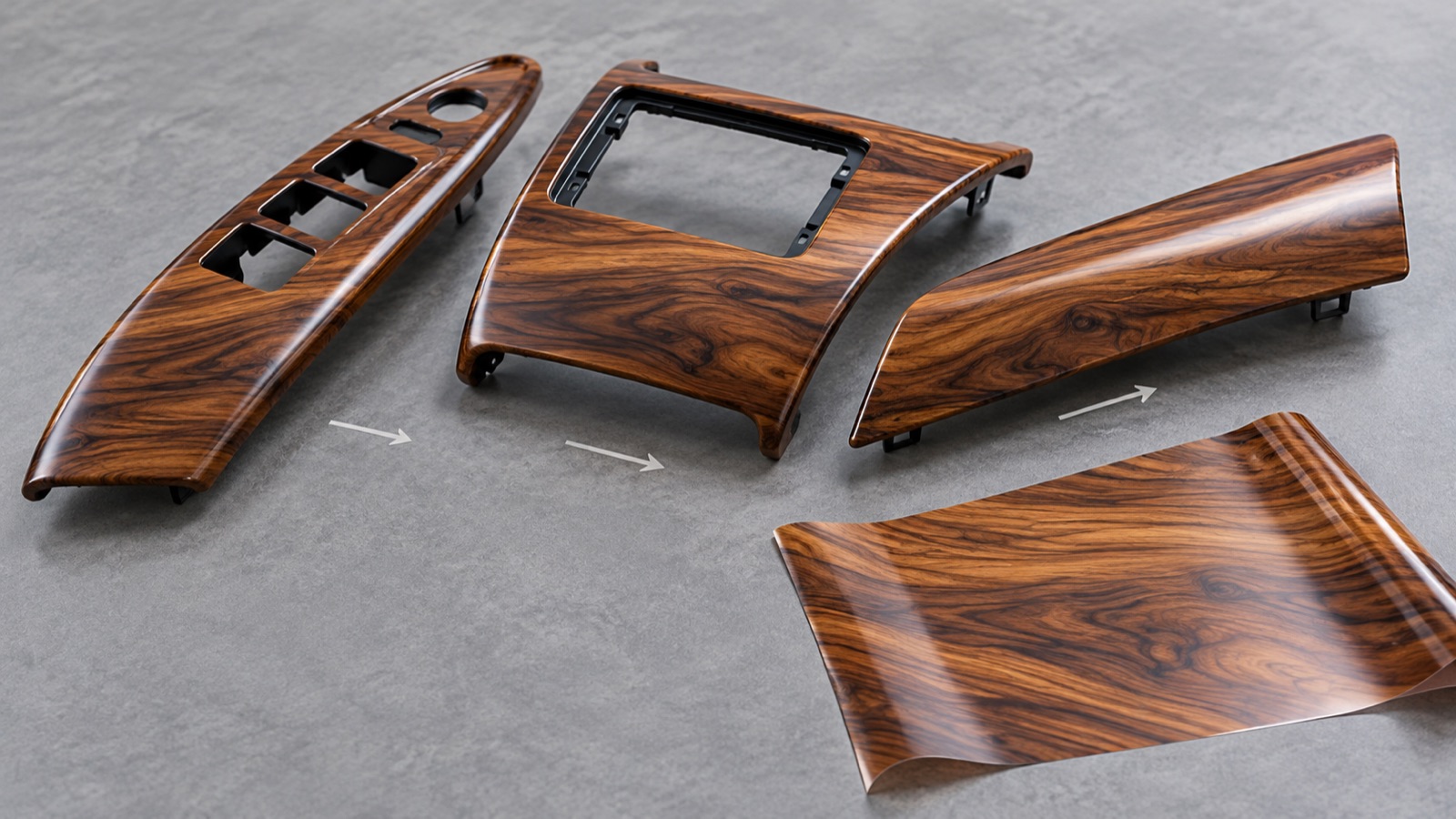
Illustration generated with AI for this buying guide; not a supplied-product or customer-project photograph.
A wood-grain film can look right on one sample yet feel inconsistent when several decorated parts are assembled. For a dashboard, console surround or a group of consumer-product panels, choose the pattern as a set of visible surfaces, not as several unrelated rectangles. The purchasing brief should tell the film supplier and the processor how those surfaces relate.
Start by comparing the existing Light Walnut Linear Grain and Red Walnut Cathedral Grain references. These help communicate the kind of grain you prefer; the website image alone is not an approval of color, scale or suitability for your part.
Mark the viewing direction on a picture of the complete set
Send one photograph or drawing showing the parts in their installed positions. Add an arrow to each main face for the intended grain direction. Identify a normal viewing position and mark surfaces that will sit next to one another. A supplier cannot infer these relationships from a folder of separate close-up photographs.
Distinguish three different requests: using the same pattern, keeping a similar grain direction, and making individual grain lines continue across a joint. The third is much more specific. If exact continuity matters, ask the processor to assess it on the assembled geometry before it becomes an acceptance requirement. Do not assume that buying the same film guarantees identical placement.
Compare pattern scale on the smallest and largest visible parts
A broad cathedral motif may dominate a narrow strip, while a fine straight grain can become less noticeable on a large panel. Review both extremes in the set. A flat printed reference at the intended scale is useful for discussion, but a representative curved sample is needed to judge how the pattern looks after application.
Industry guidance on custom hydrographic patterns also treats image scale and base color as design considerations. For your project, agree those details against a physical sample rather than treating a screen preview as the final finish.
Keep the finish variables with the pattern reference
- Pattern: the supplier-confirmed film reference and revision, if relevant.
- Orientation: arrows on the actual parts or assembly drawing.
- Appearance: the agreed base color and intended topcoat sheen.
- Priority areas: faces, joins and edges that matter most in the finished assembly.
- Sample: a dated reference that both buyer and processor can identify.
State which requirements are essential and which are preferences. A decorative match should not be confused with a material specification: a wood-grain appearance does not turn the underlying component into wood or establish its performance.
Approve the set in the way customers will see it
Place the decorated samples together in their normal arrangement. Look at the main faces, transitions and visible returns under the agreed viewing conditions. Record any requested adjustment on a labeled photograph. If only one representative part is sampled, write down which remaining shapes still need review; do not silently extend that approval to every part.
For a useful inquiry, send the assembly image, part dimensions and substrate, preferred film references, estimated quantity and delivery country. Explain whether you need film supply, pattern development or application guidance. Application support can then be discussed for the actual part set.
Browse wood-grain film references or send your matching-trim requirements to CAIYIDE. A clear grain-direction brief makes the next sample review more useful than simply asking for a darker or more realistic wood effect.